
LynxLabel inspects web print with continuous or intermittent feed. It checks defects, codes, alignment, colour and holes directly in line.
Print inspection during web feed.
LynxLabel is a vision system built for web print inspection with continuous or intermittent feed. It is built for lines where a single print defect, an unreadable code or a colour drift can compromise hundreds of metres of production.
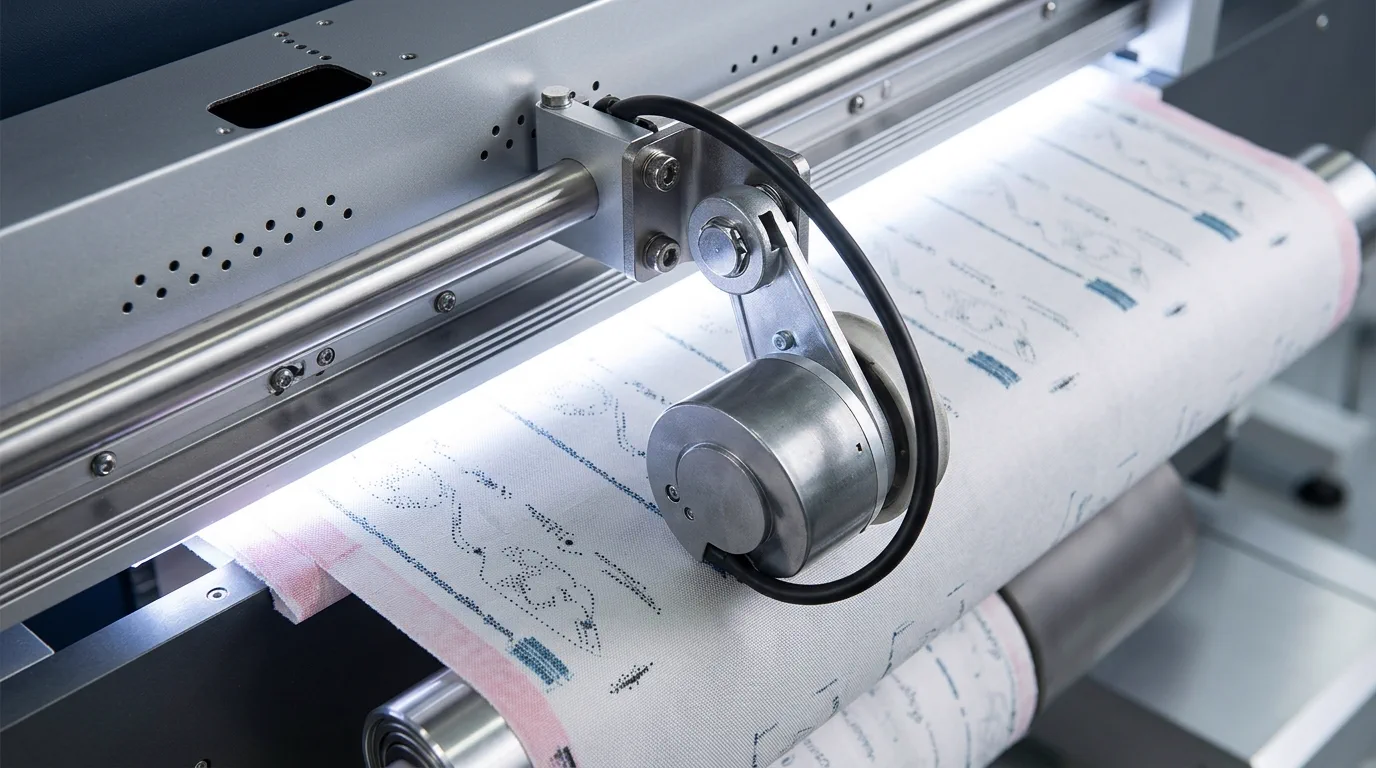
It works on paper, transparent plastic, opaque plastic and aluminium, with a configurable inspection width, up to 100 m/min with resolution up to 900 dpi, depending on substrate and line speed. Inspection adapts to the web feed.
It also supports medical materials, such as Tyvek.
- · Full-width acquisition with continuous or intermittent feed
- · Vision and AI algorithms developed in-house by Imago
- · Integration with existing printing machines
- · Full traceability of every defect detected
Numbers from the production line.
Print defects, codes and geometry.
LynxLabel identifies print defects and out-of-spec codes using checks configured for the substrate, artwork and acceptance criteria.
Ink stains
Detection of ink smudges, droplets and contamination against the configured reference.
Missing ink
Identification of graphic elements missing or partially printed compared to the reference master.
Colour shift
Continuous colour monitoring to flag variations associated with ink depletion or print-head malfunctions.
Head misalignment
Verification of registration across multi-pass prints, with warnings when alignment exceeds the configured tolerance.
Nozzle clogging
Early diagnosis of partially or fully clogged nozzles, before the defect becomes systematic.
Continuous streaks
Detection of vertical streaks associated with a faulty nozzle, within the selected imaging resolution.
1D & 2D codes
Reading and decoding of linear barcodes, DataMatrix, QR and composite codes. Quality grading uses ISO/IEC 15415 for 2D codes and ISO/IEC 15416 for linear barcodes.
Notch pitch
Verification of pitch between reference notches to ensure correct web advance downstream.
Print centring
Control of print position relative to the substrate, with warnings on horizontal and vertical drift.
Hole inspection
Verification of presence, size and position of pinfeed holes and other functional perforations.
OCR · character reading
Recognition and reading of variable printed text: batches, expiry dates, serial numbers, custom keywords.
OCV · character verification
Verification of the correctness and print quality of characters against the expected model. Any character out of spec is flagged.
Wherever print becomes identity.
LynxLabel is already installed on lines where print quality is a market requirement, a supply-chain need or a legal obligation.
Pharma labels
Batch, expiry, unique code and leaflet verified end-to-end. Support for regulatory compliance and full traceability for audits.
Food & beverage
Barcodes, nutrition tables and ingredient panels checked pixel by pixel: helping keep out-of-spec labels off the shelf.
Logistics & traceability
Reading and grading of barcodes, GS1-128 and DataMatrix. Unreadable codes are flagged by the configured inspection.
Cosmetics & perfumery
Premium printing on textured paper and transparent plastic, with colour and registration tolerances configured for the artwork and substrate.
Security labels
Unique codes, micro-text and anti-counterfeit markers checked in line where supported by the selected imaging resolution and inspection configuration.
Custom lines
Industrial labels, energy, automotive, electronics: every check is configurable for the specifics of each customer.
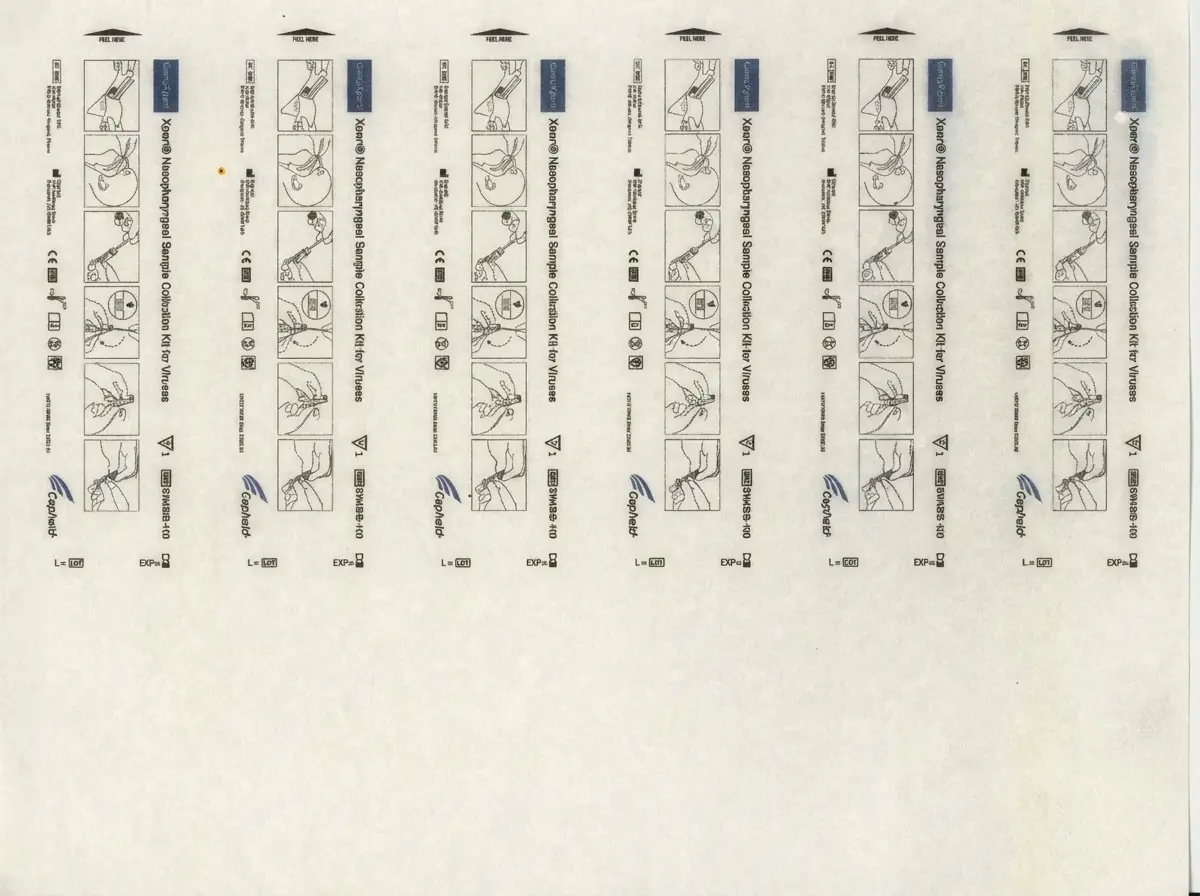
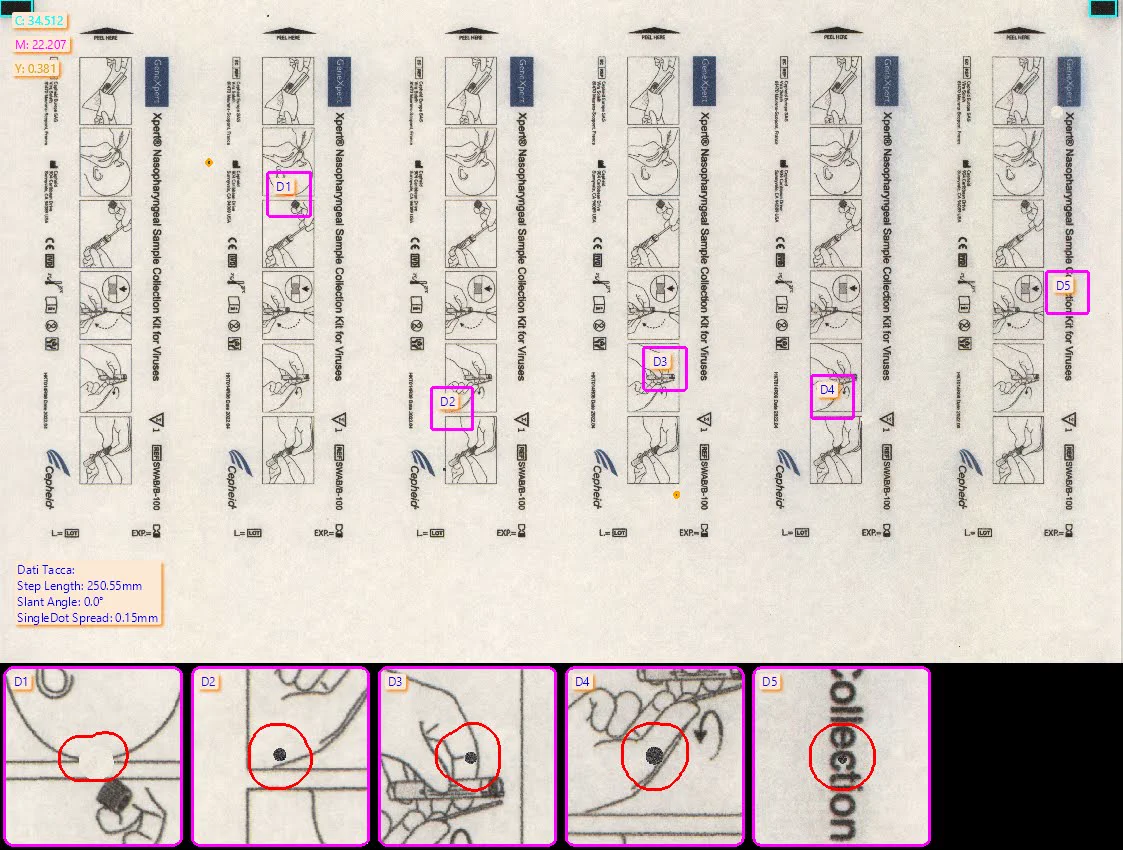
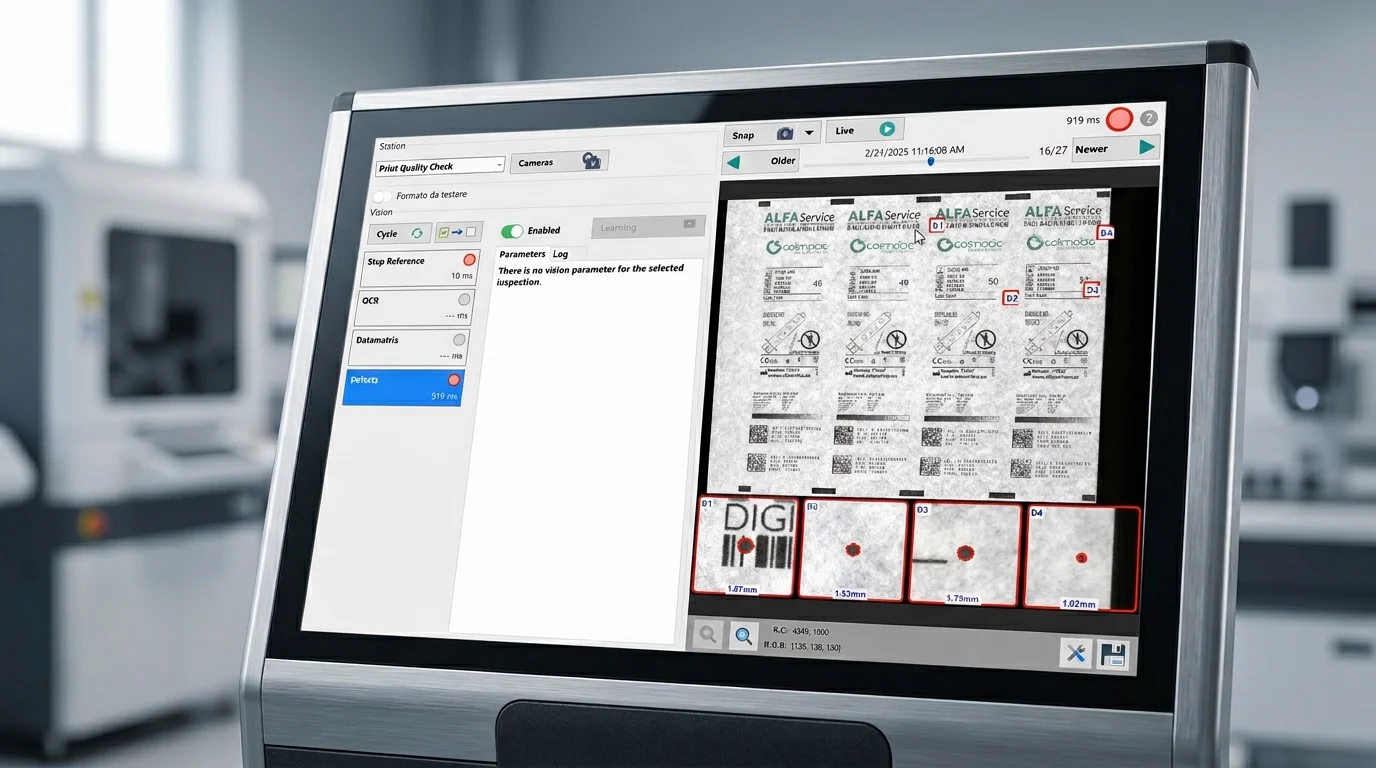
Print images and inspection results.
On the left, the label as the line sees it. On the right, as the system sees it: detected defects highlighted, classified and recorded.
The slider moves automatically. Drag it or use the arrow keys to choose a position and stop the animation. Home and End show either complete image.
An interface built for the people running the line.
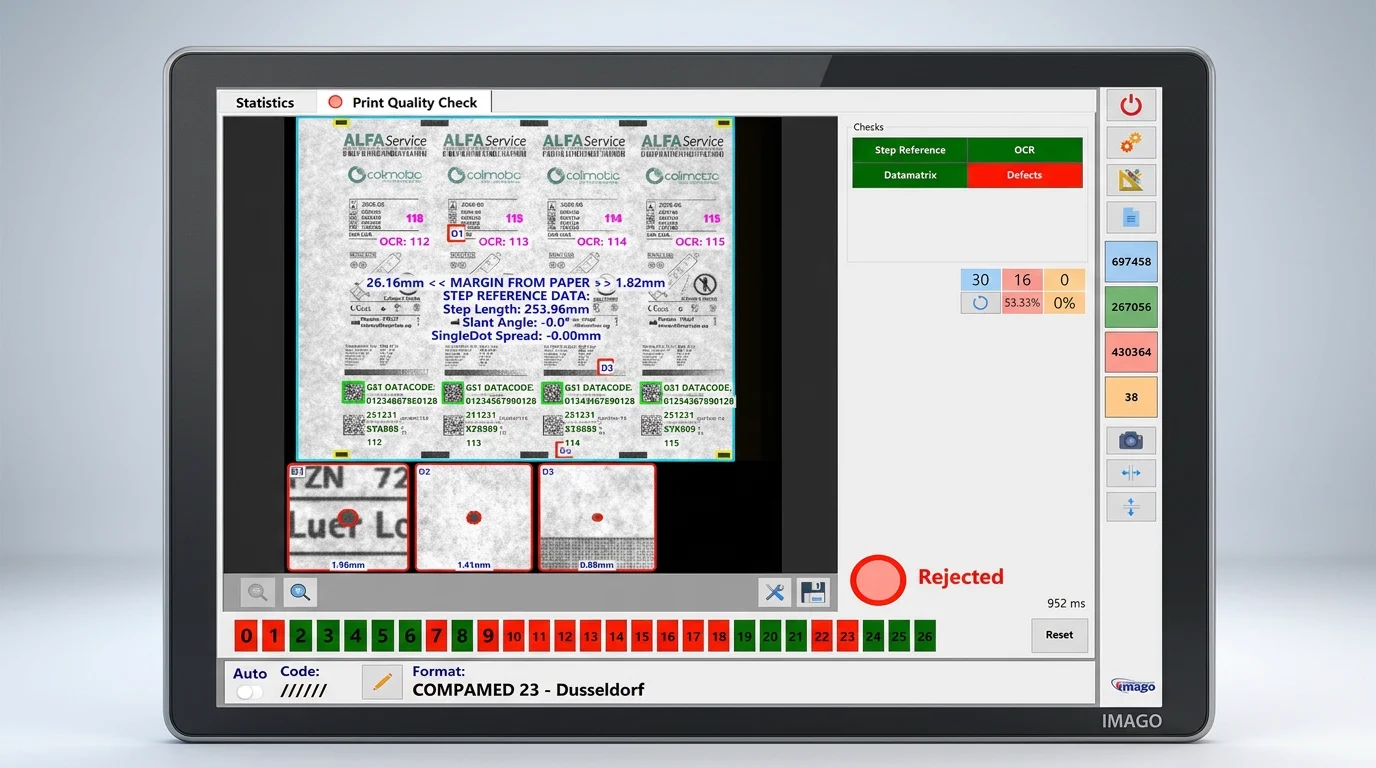
The operator sees what they need: the status of every check, the defects detected, the history, the production statistics. Results and statistics are available in the software interface.
Software functions for production
- Multi-window live view — real-time view of every inspection channel.
- Recipe-based configuration — one job per print format, callable from HMI or external signal.
- Defect history — every detection is archived with image, timestamp and defect class.
- Production statistics — waste, conformity rates, trends by shift.
- Multi-user access — differentiated profiles for operator, supervisor and technician.
- MES/ERP integration — standard data export (CSV, JSON), HTTP API, OPC UA.
- Remote support — remote diagnostics and software updates via secure, optional access.
Defects up front, conformity in the background
- Automatic annotation — every defect is highlighted on the image and detailed alongside.
- Measurements in mm — dimensions recorded for the configured geometric checks.
- Adjustable thresholds — the operator decides what is waste and what is acceptable.
- Aggregated outcomes — at a glance, you know whether production is on spec.
The Italian expertise in industrial vision.
Imago is an Italian company specialised in the development of advanced industrial vision systems. Since 2009, we have been designing solutions for automated quality control, combining traditional machine vision with artificial intelligence.
LynxLabel was born from working alongside those who work with web printing every day: reel producers, converters, industrial printers. The inspection setup is configured for the materials, print formats and production workflow.
Questions about LynxLabel?
Which print substrates does LynxLabel work on?
LynxLabel inspects print on webs of paper, transparent plastic, opaque plastic and aluminium. It also supports medical materials such as Tyvek. Lighting configurations adapt to the substrate to deliver consistent contrast even on highly reflective or semi-transparent film.
Does it integrate with existing printing machines?
Yes. The system is designed as an inspection module to be installed in-line on existing presses (flexographic, digital, offset) with no invasive mechanical changes. Integration with the press PLC is via digital I/O, EtherNet/IP, Profinet or OPC UA.
How long does installation take?
Typically 1–2 days. Imago technicians follow commissioning, calibration and operator training on-site and set up the initial recipes for the main print formats together with the customer.
How quickly can a new recipe be created?
A new recipe takes on average 5–10 minutes starting from a new print format. Once saved, it can be recalled from the HMI or an external signal, such as a format-change signal from the PLC.
What does LynxLabel check?
Ink stains, missing ink, colour shift, head misalignment, nozzle clogging, continuous streaks from a single nozzle, reading and grading of 1D and 2D codes, OCR, OCV, hole presence and size, print centring, correct notch pitch.
What line speed can it sustain?
LynxLabel inspects web printing with continuous or intermittent feed, at speeds up to 100 m/min. Inspection width is configurable according to the web and the selected CIS modules, with resolution configurable up to 900 dpi. Maximum resolution depends on the substrate and line speed.
How are inspection data stored?
Every detection is stored with image, timestamp, position on the web and defect class. Data can be exported as CSV/JSON, queried via HTTP API or OPC UA and integrated with the plant MES/ERP.
Is an internet connection required?
No. LynxLabel runs fully offline inside the plant network. Internet is only needed for software updates and remote support — both optional and handled via secure VPN.
What maintenance does it need?
Minimal: monthly cleaning of the optical and lighting modules with a soft cloth and isopropyl alcohol. Optics are protected by dedicated housings. There are no moving mechanical parts in the optical path.
What support services do you offer?
Imago has an in-house Service department, active during Italian business hours, with remote assistance.
Show us your print. We'll show you what it checks.
Tell us about your process so we can assess the inspection requirements and arrange a demonstration if useful.
Or write directly to info@imagovision.it · +39 030 366 0034